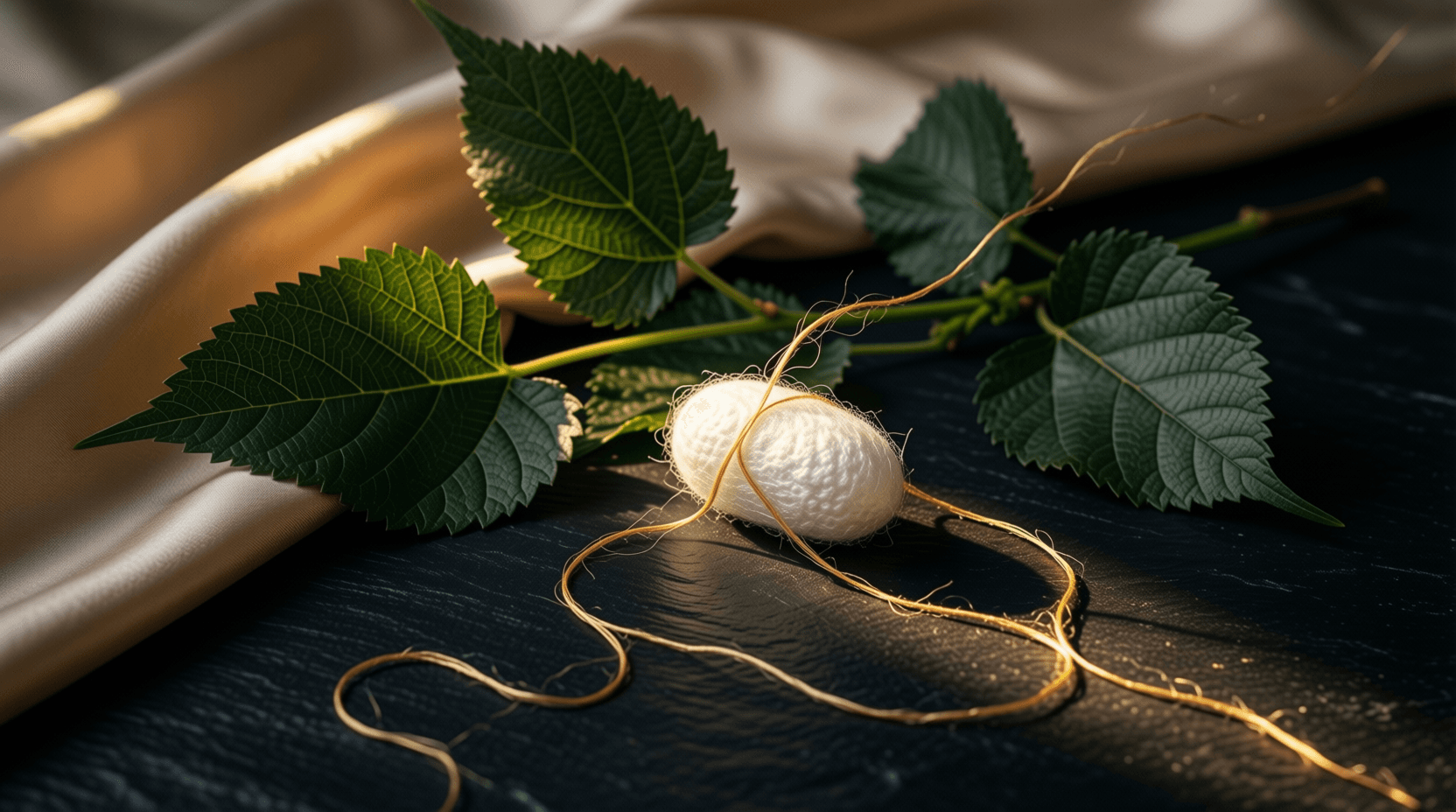

Guides
Momme: the silk weight your skin can feel
7 min read
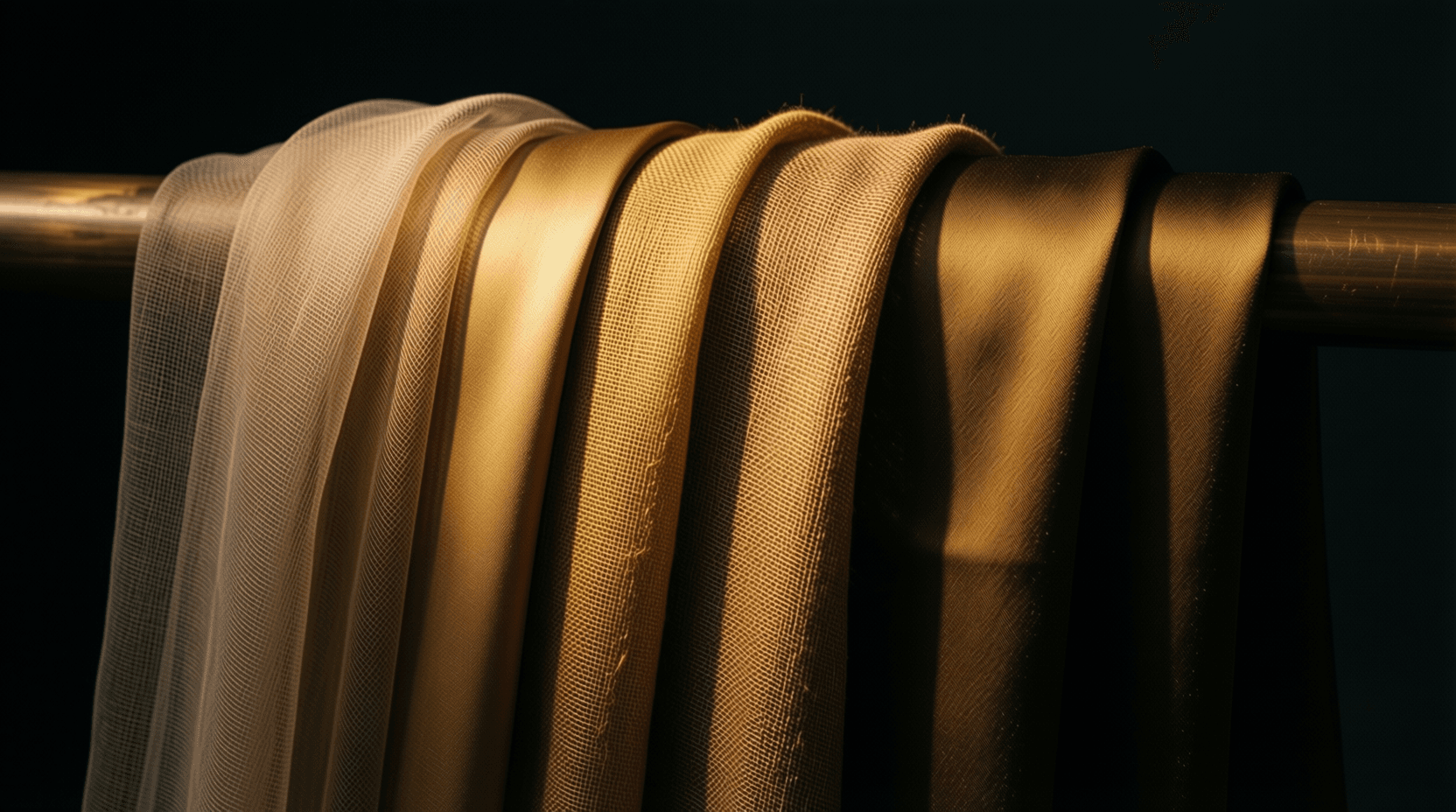
Two scarves lie side by side on a dark counter. The same colour, the same satin weave, the same label reading one hundred per cent silk. One pours off the hand like water and settles into deep, soft folds. The other hangs shallower, stiffer, as though it would rather stay flat. The difference is not in the fibre. It is in a number the label usually leaves out.
That number is momme. It stays untranslated because there is nothing to translate: it is a unit, not an adjective. It measures the weight of the cloth, and through weight it tells you everything else — how silk falls, how much light passes through it, how it survives washing, and why two apparently identical nightdresses never cost the same.
A measure invented for bolts of silk
The definition is disarmingly physical. One momme is the weight, in pounds, of a hundred yards of fabric forty-five inches wide. It sounds like a relic of a trade conducted in bolts rather than metres, and that is exactly what it is. Translated into workshop language, one momme is roughly 4.34 grams per square metre.
The rest is multiplication. Silk at 19 momme weighs just under eighty-three grams per square metre; at 22 momme, around ninety-six. Thirteen grams looks like nothing on paper. In the hand it is the difference between cloth that lifts with movement and cloth that falls straight down and stays where it was put.
Two measures are easily confused and worth separating. Denier describes the thickness of a single yarn, which is why it rules the world of hosiery. Momme describes the whole cloth — its mass, not its thread. Heavy silk can be woven from fine yarn and light silk from a coarser one, so only the weight of a finished metre tells you what you are actually holding.
The scale worth memorising
Mills work within a narrow band, and every part of it has its purpose. Below twelve momme silk turns nearly transparent and behaves more like a veil than a working fabric. Above twenty-five it becomes rare — not because it cannot be woven, but because it loses the lightness silk is chosen for in the first place.
- 12–16 momme — scarves, squares, linings, the airiest blouses
- 16–19 momme — night and day lingerie with a calm, reliable weight
- 19–22 momme — bedding, pillowcases, heavier lingerie and robes
- 22–25 momme and above — the densest cloth, matte-lustred and scarce
The interesting things happen between sixteen and nineteen. That is where lingerie stops being wispy and has not yet turned heavy; where the fabric begins to hold a strap line and stops clinging with every movement. For most slips, pyjamas and light kimonos that band remains the point of balance.
19 vs 22 momme: the difference you feel
These two numbers sit next to each other on almost every silk description, and the choice between them decides more than it appears. At 19 momme a long slip traces the body and answers every draught in the room. At 22 it draws its own line: it falls from the shoulder in one continuous movement and makes a single fold at the hip instead of three.
Nineteen is the better traveller. It packs smaller, dries faster, and reads as lingerie in warm weather without becoming a garment you have to manage. Twenty-two is the better keeper. It survives more washes, resists the slow stretch of a strap, and carries a deeper, quieter lustre because the light has more surface to work with.
Neither is superior; they are answers to different questions. A bias-cut gown asks for weight to do its work. A gathered camisole or a pleated trim asks for the opposite, because the lighter the cloth, the livelier the detail. The same number can be a virtue in one design and a mistake in the next.
You do not recognise the weight of silk by looking at it, but by how long the cloth takes to come to rest after your hand has moved.
How much light the cloth allows
Opacity grows with weight, though not in a straight line. Twelve momme dissolves into mist at a window. Sixteen still lets a clear outline through, especially in pale shades. Nineteen in a deep colour — ink, heather, black — is practically opaque, while the same nineteen in ivory can surprise you in direct sun.
Dye plays a larger part than most descriptions admit. Dark pigment fills the spaces between threads and absorbs light; pale pigment reveals them. For anything meant to be worn beyond the bedroom, read two values at once: the momme count and the depth of the colour. Alone, neither tells the whole truth about what daylight will find.
Weave adds its own correction. Charmeuse throws the light back from one face and therefore looks thinner than it is. Crêpe of identical weight scatters that light across a fine grain and reads calmer, more matte, almost woollen. The same momme count can give two entirely different impressions before the cloth has touched the body at all.
Weight, washing and what remains after years
Heavier cloth endures more. There is simply more material at every point of friction, so seams fray later and straps stretch more slowly under their own load. Nineteen and twenty-two momme forgive a lapse — one wash too warm, one night on a wire hanger — that twelve will never forgive at all.
This is no licence for carelessness. Silk remains a protein and still dislikes heat and alkaline detergents whatever its weight. Density buys time, not immunity. A heavy silk piece ages more slowly and more gracefully, but it ages in exactly the same way: it loses its lustre by degrees rather than all at once.
Why higher momme weighs beyond the cloth
The reason is plain and honest. Heavier fabric means more raw material in the same metre: more cocoons, more yarn, a slower loom and longer time on it. Moving from sixteen to twenty-two momme means close to forty per cent more material, and silk thread does not become cheaper because someone orders a great deal of it.
Which gives the reader of product descriptions a useful rule. Weight is one of the very few specifications that translates directly into what a garment costs to make. If the cloth is to be dense, it will not be cheap — that is the arithmetic of the raw material, not a decision of the house. In that sense the momme count is the most candid line on any product page.
It is worth remembering that weight never works alone. Twenty-two momme badly dyed, badly finished or cut across the grain will squander every gram it carries. The number is a promise about the raw material, not a guarantee of tailoring — the seam, the edge finish and the direction of the cut decide whether that weight becomes a line or merely a burden.
Reading the claims, and knowing when not to believe them
A serious description gives three things: composition, weave and weight. One hundred per cent mulberry silk, charmeuse weave, 22 momme. The absence of any one of them proves nothing on its own, yet silence about weight specifically tends to appear where there is little to boast about.
Numbers can also be too beautiful. Thirty momme in a floating spaghetti-strap chemise is a contradiction, because such cloth would weigh like a light curtain. So is a claimed 22 momme on fabric that stays cool and slippery in the hand and springs back instantly: dense silk warms faster to the touch and answers noticeably more slowly.
The simplest test is domestic. The same scarf size in a higher weight simply weighs more, and folded into a square it takes up visibly more room in the palm. When two supposedly different fabrics sit identically in the hand, one of the two claims is not telling the truth.
Back to the two scarves on the dark counter: the one that poured like water was 22 momme. The other was fourteen. Both were silk and both labels were honest. Only one of them finished the sentence.
Momme is not a number for collectors of specifications. It is the shorthand by which cloth tells you how it will behave over the coming years — in the hand, on the shoulder, after the twentieth wash. At YES VERSE the weight is chosen before a single word is said about the cut, because everything that follows happens on its terms.