
Guides
Mulberry Silk, Explained: Where the Finest Fibre Comes From
7 min read
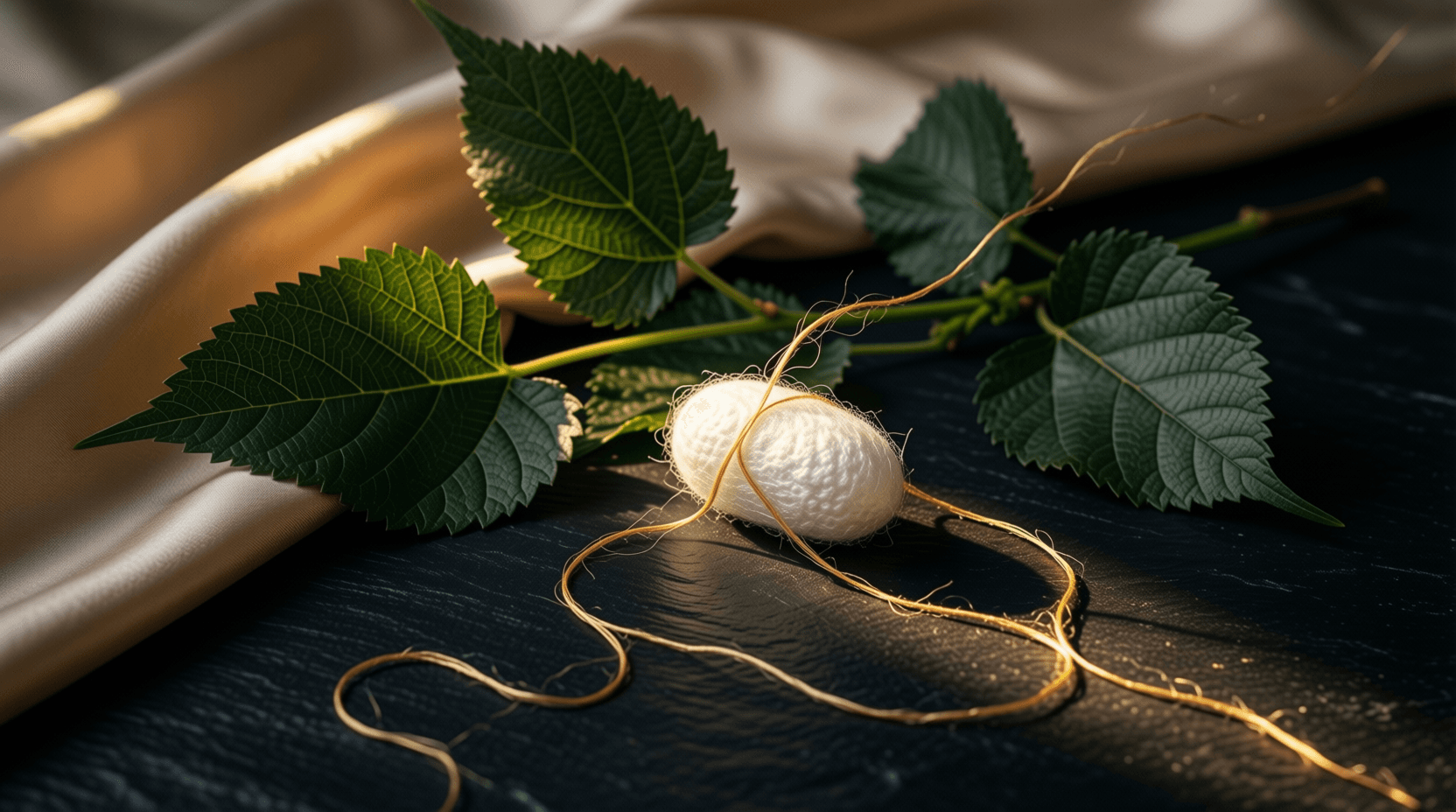
The cocoon is the size of a thumb and chalk white. Shaken beside the ear it gives a dry knock — the pupa inside, come loose from the wall. That whole shell is a single thread, wound in figures of eight for three days without pause, and unwound it would run the length of a good walk.
Mulberry silk begins exactly there: on a leaf, in the shade of a tree whose name has stayed attached to the cloth for good. Everything that separates it from other silks — the coolness under a finger, the even lustre, the quiet sound it makes in movement — follows from what the caterpillar eats and how long a filament it leaves behind.
The caterpillar that knows only one leaf
Bombyx mori, the mulberry silkworm, has been domesticated for more than five thousand years and has given everything it had over to us. The adult moth can neither fly nor feed itself. The larva eats the leaves of the white mulberry, Morus alba, and will touch nothing else at all.
The whole cycle runs about thirty days. In that time the caterpillar passes through four moults and multiplies its weight roughly ten thousandfold, eating almost without pause, through the night as well. The diet is monotonous and clean: mulberry leaf carries no resins and no heavy tannins to stain or stiffen the fibre to come.
That monotony is the entire secret. Identical food, held temperature and held humidity produce a protein of consistent composition, and therefore a filament of consistent diameter. It is why the cocoon comes out chalk white rather than beige, and why silk reeled from it takes dye so evenly.
One filament, six hundred metres
For two to three days the caterpillar extrudes a single continuous filament from its spinnerets, swinging its head in figures of eight dozens of times a minute. A single cocoon yields between 600 and 900 metres of thread without one break, and the finest specimens run past a kilometre.
Length matters more here than it sounds. A continuous filament twists into a thread from which no thousand short ends protrude — and it is those ends that, in every other kind of yarn, cause pilling, dulling and that roughness which arrives after a few washes. The smoothness of mulberry silk descends directly from this continuity.
Cocoons are softened in hot water and reeled several at a time, their filaments bonded by the remains of their own gum into one raw thread. This step is done by hand or by machine, and every stumble in it returns later in the cloth as a slub that no finishing will hide.
Sericin and fibroin: two proteins in one filament
A silk filament is not uniform. Two parallel strands of fibroin run through the core — a structural protein arranged in what chemists call beta sheets. Around them sets sericin, a protein gum that makes up twenty to thirty per cent of the raw thread's weight and holds the cocoon together.
Raw silk is consequently stiff, matt and unpleasant to touch. Only degumming — simmering in a mildly alkaline soap bath — dissolves the sericin and releases the thing one reaches for silk to get. The cloth loses about a quarter of its weight in the process and gains everything else.
Stripped fibroin has a cross section close to a triangle with rounded sides. Light striking that prism scatters at several angles at once, producing a lustre whose depth shifts as the fabric moves. At equal diameter, the filament resists tension better than a strand of steel.
Wild tussah, and what it lacks
Tussah is the silk of wild Antheraea moths feeding on oak, apple and other fruit trees. The tannins in those leaves stain the cocoon a broken beige or gold, and that colour cannot be drawn out without harming the fibre. Hence the warm, characteristic tone of tussah cloth.
The second difference matters more. Wild cocoons are often gathered after the moth has emerged, and in emerging it breaks the filament in many places. What remains are short lengths that have to be spun like wool. The result is a fabric of visible texture, uneven thread and a matt, faintly raw character.
This is not a fault. Tussah has its place in shawls, throws and interiors, where its rougher beauty earns its keep. Against the skin, though, it loses: it is thicker, less smooth and less predictable. Lingerie needs a fibre with no character at all, only consistency.
Grade 6A and the rest of the alphabet
Raw silk thread is classified on a scale that looks unremarkable: from C through B and A, then 2A, 3A and onward to 6A. What is judged is evenness of diameter along the whole length, cleanliness, tensile strength, elasticity, and the count of defects per kilometre of filament.
Grade 6A means thread reeled from the best cocoons: long, uniform, free of slubs and breaks. In practice it shows in the cloth rather than in the skein. Fabric from 6A dyes evenly, dries without watermarks and does not pill along the seams that rub against the body all day.
Grade describes the thread; momme describes the cloth — how much a given quantity of it weighs, which is to say how dense and how substantial it is. They are two entirely separate measures, and momme deserves its own telling. One thing suffices here: even the heaviest satin woven from grade B thread will never behave like 6A.
The whole difference between one silk and another sits in a single leaf and a single unbroken filament. Everything after that is consequence.
Why the skin recognises it
Mulberry silk takes up to thirty per cent of its own weight in moisture without feeling wet, and releases it into the air as it dries. From this comes its double-edged thermoregulation: it cools when the air is hot and holds warmth close when the air turns cold.
The polished triangular surface of the filament gives the lowest friction of any cloth worn against the body. This is not an impression but a measurable quantity, and it is what accounts for the absence of redness where a seam or a strap works all day on the same strip of skin.
With the sericin gone, what remains is a neutral protein close to the skin's own pH, in which dust mites find nothing to live on and moisture never lingers long enough to favour mould. This is why mulberry silk appears in recommendations for atopic and reactive skin.
What it means when cloth touches skin all day
Lingerie is the hardest task anyone can set a fabric. A narrow strap carries weight, a seam runs along the ribs, the cloth works with every breath and every step, and between it and the skin there is nothing at all to soften the difference.
A long continuous filament means a seam that will not fray from the inside after the twentieth wash. An even thread means a drape that falls softly instead of breaking into sharp folds at the hip. A consistent diameter means the colour is the same at the front and at the back, a season later as well.
And then there is the coolness of the first second. Mulberry silk laid against the body feels cooler than the air around it, and a moment later it has matched the skin's own temperature and ceased to be felt. It is the only fabric one forgets that quickly and that completely.
The cocoon is still the size of a thumb. Around two and a half thousand are needed for a single dress and considerably fewer for a camisole that folds into one hand — but every one of them is the same three days of a head swinging in figures of eight, and the same filament drawn without a single break.
At the YES VERSE atelier that arithmetic stays at the back of the mind with every cut. Not out of sentiment, but because cloth that comes into being this slowly deserves a pattern that will outlast one season, and a seam sewn without hurry.
See in the shop: silk lace bralette and silk lace thong.