
Guides
Charmeuse, crêpe, habotai. A guide to silk weaves
7 min read

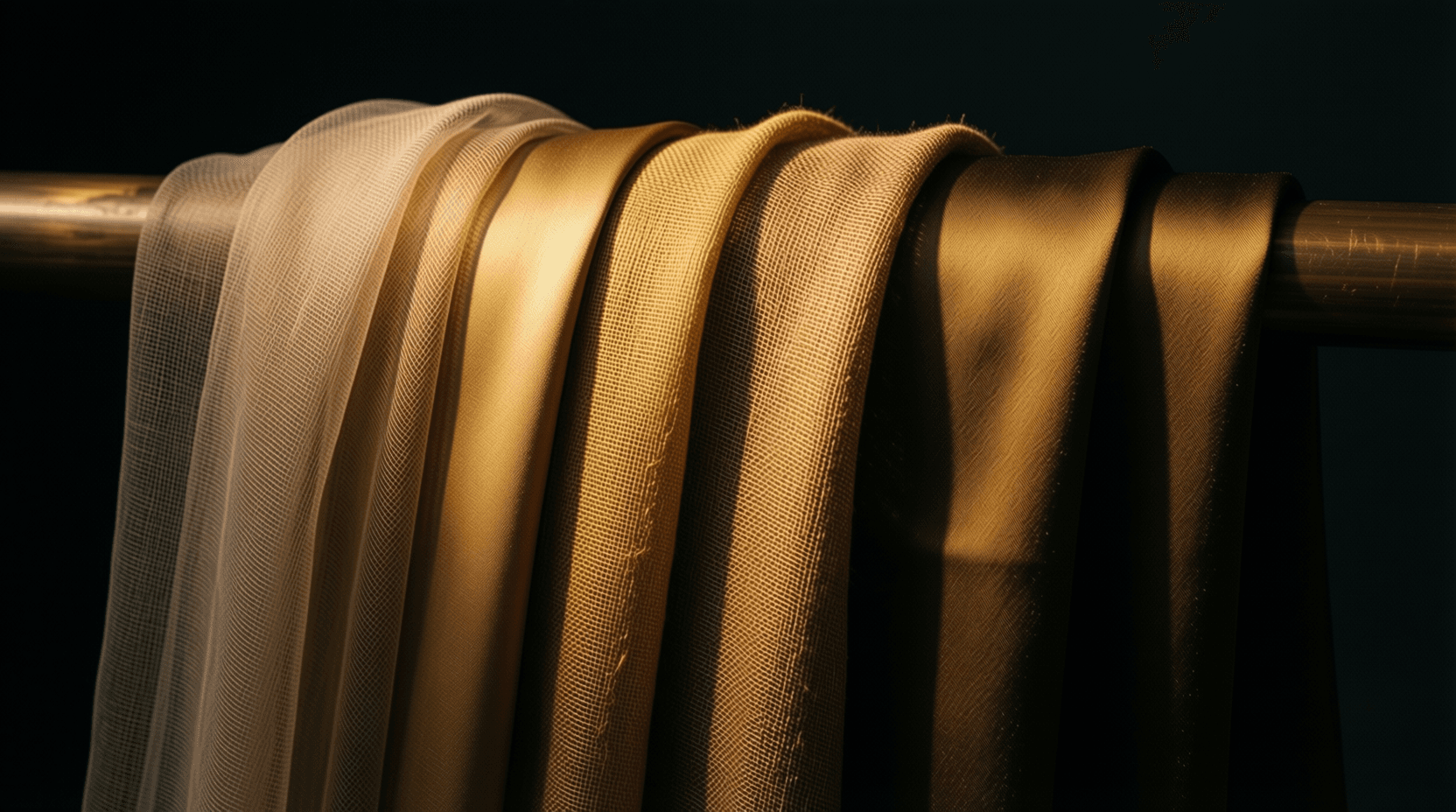
Two fabrics lie side by side on the cutting table. Both are silk, both come from the same kind of thread. One pours off the edge of the bench like spilled water, the other stops in mid-air and returns to itself, as though it held an opinion.
The difference is not made by the fibre but by the way it was twisted and interlaced. Those names on the label, which read like a list of stops on a journey, are in fact descriptions of temperament. They are worth knowing, because they say more about how a piece will wear than any product description can.
Fibre, yarn, weave: three different things
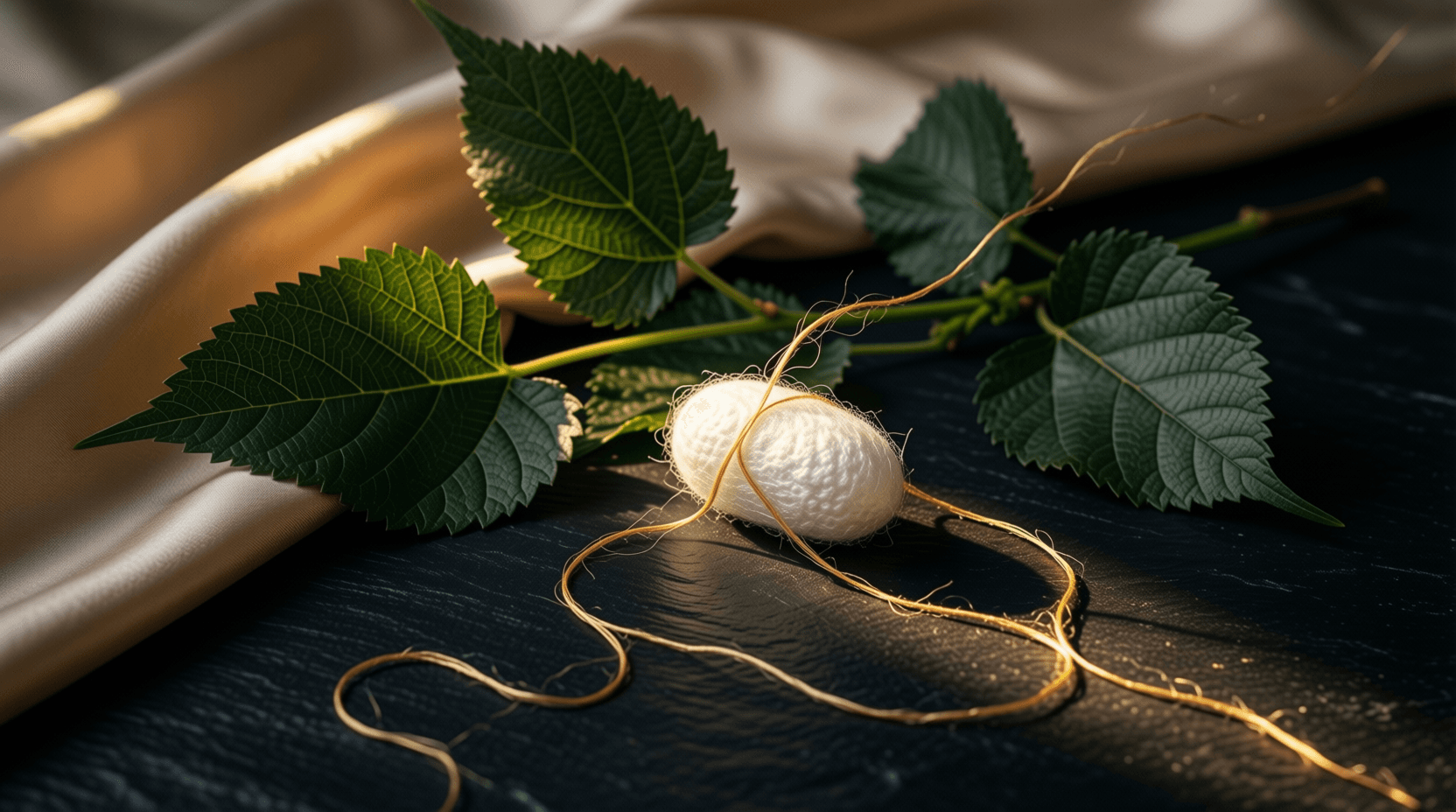
Silk is a fibre, not a fabric. It is raw material: one continuous filament a silkworm spins around itself, measured not in centimetres but in hundreds of metres. What happens to that filament afterwards decides everything the skin will later feel.
First the yarn. The filament can be left almost straight or twisted hard, several hundred turns to the metre. Twist takes away lustre and gives back spring. Then the weave: satin, plain, twill, each with a different number of crossings. The fewer times the threads meet, the longer the sections that lie on the surface, the more light they return and the more the cloth flows.
Which brings up the confusion that arises most often: satin is the name of a weave, not of a material. It can be woven from polyester and from silk, and the difference under the hand is the difference between glass and water. Silk charmeuse is a satin, but not every satin is silk.
Momme, the number that says more than the name
On the labels of better fabrics a figure stands beside the name: 16 mm, 19 mm, 22 mm. That is momme, an old Japanese measure of weight still used for silk alone. The higher it goes, the heavier and denser the cloth.
The scale is surprisingly legible. Six to eight momme is a veil you can see a hand through. Twelve to sixteen is the usual weight of a blouse or a light dress. Nineteen already has clear heft in the hand and settles into soft folds. Twenty-two and above is reserved for bedding and for pieces meant to survive hundreds of washes.
The unit comes from the days when silk was reckoned in Japanese weight measures, and it survived because it proved practical. One momme is roughly four and a half grams per square metre, so a nineteen momme cloth weighs around eighty grams. The number says nothing about the density of the weave or the quality of the dyeing, but a great deal about how a piece will fall.
A higher number does not automatically mean a better fabric. It means a different task. A lining woven at twenty-two momme would be unwearable under a jacket, and a nightdress at eight momme would not last a single season.
Charmeuse: the lit side and the matte one
Charmeuse is what most people mean when they say silk. The satin weave carries a warp thread over several wefts at once, so the surface becomes an almost unbroken band of light. The reverse stays matte and faintly rough, which is the simplest way to recognise this weave with your eyes closed.
The construction gives weight that falls straight down. A charmeuse slip does not stand on the body, it runs down it, and for that reason it shows everything underneath without mercy. It has its demands too: long floats catch easily, and every fingernail leaves a fine pale line in the weave.
It is pressed from the reverse only, through cotton, at the lowest setting. An iron set directly on the face flattens the long floats and leaves a paler matte field whose lustre cannot be brought back.
Crêpe: a grain that does not cling
Crêpe de Chine is made from yarn twisted very hard and, moreover, alternately to the right and to the left. The effect is visible to the naked eye: the surface carries a delicate irregular grain and the shine turns into a deep matte glow.
Worn, crêpe behaves nothing like charmeuse. The spring in the twist keeps the fabric standing away from the body instead of sticking to it, creases less and forgives more. Georgette is the same principle taken further: crêpe yarn in both directions, sheer cloth, slightly dry to the touch and full of air.
If silk is to be worn in heat, on a journey or through a whole working day, crêpe is usually the wiser choice than satin. It is the same thread, only better prepared for life.
Habotai, pongee, organza: lightness by different means
Habotai, also known as pongee, is plain weave in its simplest form: thread over thread, with no tricks. Light, smooth, cool, in weights from five to twelve momme. It becomes linings, scarves and those parts of a wardrobe meant to remain invisible. It is also the least durable of the family, because a plain weave holds no reserve of thread to absorb strain.
Organza is its opposite despite the identical weave. It is woven from yarn twisted so hard that the cloth turns crisp and rustling while staying entirely transparent. It does not flow, it holds shape, which is why it appears wherever form is required: in a sleeve, in a flounce, in the layer that has to lift another.
Mulberry, tussah, dupion: where unevenness comes from
Mulberry silk comes from the cultivated Bombyx mori, fed on mulberry leaves alone. The filament is long, uniform and naturally pale, so the cloth is smooth and takes dye evenly. This is the silk that momme numbers describe.
Tussah is gathered from wild cocoons opened after the moth has left. The fibre is shorter, darker, with a warm natural cast that cannot be bleached out entirely. The resulting fabric is more matte, with a texture you can feel.
Dupion is woven from double cocoons, spun by two caterpillars side by side. The tangled filaments create the characteristic slubs that run across the cloth in irregular bands. It is not a flaw in the making but the signature of the raw material, which is exactly why dupion goes where a fabric is meant to have a drawing of its own.
How to check all this by hand
Names help, but the last word belongs to the hands. A piece of cloth drawn between the fingers will say more about the weave than any label: charmeuse pours and stays cool, crêpe offers slight resistance and warms faster from the skin, organza stops where it is.
Light is worth watching too. Real silk does not throw back one flat flash but changes shade as it moves, because the triangular cross-section of the fibre scatters light like a prism. That is why black silk in motion looks deeper than black polyester, and why white silk is never entirely white.
A simple crush test helps as well. Silk squeezed in the hand and released opens slowly but does open, and the spot stays warm a moment longer than intuition suggests. Man-made fibres spring back at once or not at all, and stay cool no matter how long a hand has held them.
Silk is not one fabric but a family of temperaments woven from the same thread.
The two pieces on the cutting table are still lying side by side. One will become a slip meant to disappear under a dress, the other a sleeve meant to hold its shape all evening. Both decisions were made before anyone thought about the cut.
Knowing your weaves is not collector's knowledge. It is what allows you to buy less often and more accurately, because it lets you tell whether a fabric will do what you expect of it before you ever put it on.