
Guides
DEN, the Density of the Senses: What the Number on a Stocking Box Really Means
7 min read
A box of stockings carries surprisingly few words. A name, a size, sometimes the promise of a silken touch — and a number. Eight, fifteen, forty, sixty. Next to it, three letters: DEN. Most of us slide past them as if they were a technicality for insiders. Yet it is the most honest piece of information on the entire box — the number that tells you how the stocking will look on the leg, how it will handle a cool evening, and whether it will gleam or stay matte by candlelight. You only need to learn to read it.
This guide asks you to memorise no formulas. It asks for a single image: nine kilometres of thread laid on a scale. Everything else follows from it.
Nine kilometres of thread: a definition that fits in your palm
Denier is a unit of linear mass: it tells you how many grams exactly 9,000 metres of yarn weigh. Fifteen denier therefore means that a thread long enough to cross half a city and come back weighs fifteen grams — less than two teaspoons of sugar. The lower the number, the finer the thread; the finer the thread, the more transparent the knit it becomes. The entire mystery of a stocking's sheerness, warmth and weight begins with that single weighing.
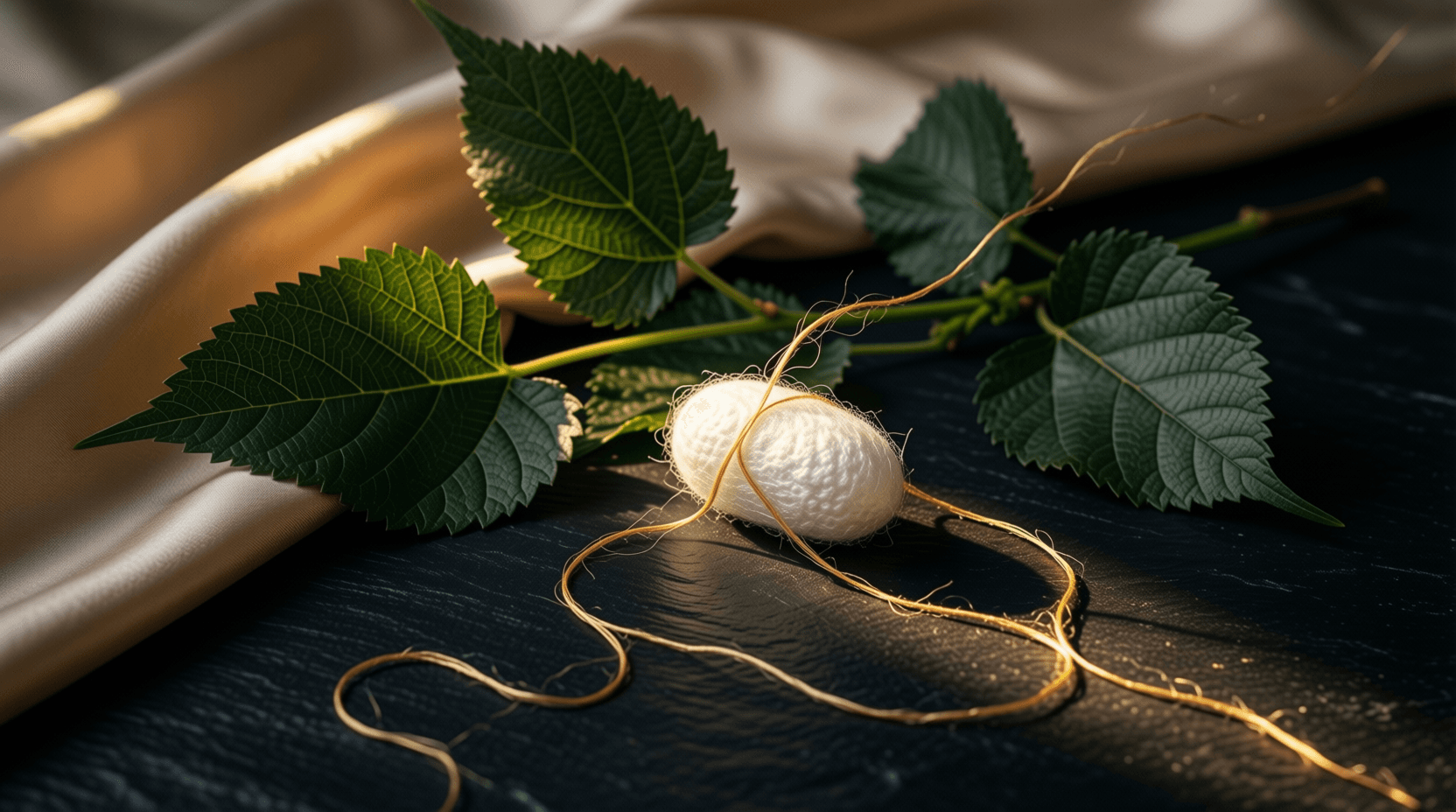
The unit is older than nylon, and older than the stocking as we know it. The name descends from the denarius — a Roman coin that travelled through the French denier into the language of silk merchants, who needed a way to describe the fineness of a yarn honestly before anyone could hold it up to the light. The choice of 9,000 metres was no whim: over that distance, a single filament of natural silk weighs roughly one gram. One denier is literally the thickness of a silkworm's thread. Modern industry has long had a metric alternative — tex, grams per kilometre — but hosiery has stayed loyal to the scale invented for silk. It is hard to imagine a finer pedigree.
Nylon merely inherited the scale. When the first nylon stockings reached American department stores in 1940, they were described in denier — and so a number invented for silkworms began to describe a synthetic meant to be stronger and cheaper than silk. Eighty years on, it is still the same alphabet: from five to one hundred, from mist to velvet.
From mist to velvet: DEN ranges in practice
The numbers on the boxes fall into four distinct registers. Each has its own character, its own occasions and its own demands.
5–10 DEN: the bare-skin effect
The thinnest stockings in the world are almost an optical illusion — a mist that evens out the tone of the leg without admitting it exists. They are the choice for weddings, summer receptions and every situation where etiquette requests stockings and the weather votes against them. The price of that lightness is well known: a knit made of thread weighing five grams per nine kilometres forgives very little. You put it on slowly, from the toe up, with hands free of jewellery — not out of excessive caution, but out of the simple arithmetic of physics.
15–20 DEN: the classic of office and evening
The register where most of a wardrobe lives. Still transparent, but present: the leg gains an even tone, a delicate shadow and — in glossy versions — a streak of light running down the calf. Fifteen denier is the language of diplomacy: formal enough for a board meeting, sensual enough for the dinner that follows it.
30–40 DEN: the semi-sheer transition
Here colour begins to speak at full volume. Black at 30–40 DEN is black, not a suggestion of black; the leg shows through only at a bent knee and in strong light. It is the natural choice for October and March, for tweed, flannel and knitted dresses — a density that warms the outfit before it warms the body.
60 DEN and above: opaque, winter-ready, architectural
Above sixty denier, transparency disappears and surface begins: matte, uniform, graphic. The stocking stops being a veil and becomes a structural element of the outfit — a black column on which an entire silhouette can be built. Microfibre versions add real warmth, because finer fibres pack more densely and trap more air.
This is also the place to settle the question of temperature, because DEN is a measure of warmth too — an indirect one. A knit warms not with its fibre but with the air it immobilises between the stitches; denser yarn and a tighter knit trap more of it. Hence the simple arithmetic of the seasons: ten denier is July, forty is November, eighty with microfibre is January at minus ten. If your ankles are always cold, look not only at the number but also for the word “microfibre” on the box.
The number describes the thread, not the stocking
DEN measures the yarn — what it becomes on the leg is decided by the knit. Two pairs of identical weight can look entirely different: stitch density, the way the thread is guided and the surface finish shift the impression several deniers up or down. A glossy version reads thinner, because light glides across it in a single sheet; matte absorbs light and optically adds coverage.
The second quiet hero is elastane. In good stockings it never appears as a bare rubber thread but as a core wrapped in polyamide — ideally twice, in opposite directions. Yarn like that springs back into shape thousands of times, does not shine and does not ladder at the first stretch. Which is why two pairs marked “20 DEN” can share a price shelf and inhabit two different worlds: the difference is decided by what the box does not print in large type.
Fifteen denier means this: nine kilometres of thread that weigh less than a love letter.
The matrix: occasion, season, skin tone
Instead of guessing at the shelf, line up three questions: where am I going, what is the temperature, and what should the world see — skin or colour.
- Wedding, summer gala: 5–10 DEN in a shade perfectly matched to the skin; with a tan, half a tone darker — never lighter.
- Office, formal meetings: 15–20 DEN — nude with light outfits, black with a suit or a pencil skirt.
- Evening, dinner, theatre: 15–20 DEN with a subtle gloss; a streak of light on the calf does more than jewellery.
- October–November, March–April: 30–40 DEN, semi-sheer black or deep shades — plum, bottle green.
- Winter: 60–100 DEN, matte or microfibre; the colder it gets, the higher the number and the denser the knit.
- The nude shade: matched to the skin's undertone, not its lightness — cool rose or warm beige; test it on the wrist, not the palm.
One overriding rule is worth remembering: the more formal the occasion, the lower the DEN — and the greater the care while putting them on. An evening forgives colour, but it does not forgive a ladder.
A myth to retire: higher DEN means more durable
Intuition says thicker means stronger. In practice a stocking's lifespan depends only slightly on the weight itself, and heavily on the quality of the yarn, its twist, the way the elastane is covered and the reinforcements at the toe and gusset. A carefully made 15 DEN with double-covered elastane can outlive several cheap pairs of 40 DEN whose thread loses its spring in the first wash.
There is a second reason: a snag never asks about weight. A ladder forms on a 60 DEN stocking as easily as on a 15 — on the dry skin of a heel, on a boot zip, on the edge of a chair. The only difference is that dense black shows it sooner. Durability is built elsewhere: with the right size (stockings that are too small work under constant tension and give way at the seams), with rolling them on from the toe, with washing in a mesh bag and cool water. The number on the box describes character, not resilience.
Reading the box like an expert
Next time at the shelf, that small number will tell you more than the photo of the model. Five is a whisper, fifteen a conversation, forty a statement, eighty architecture. Add one glance at the composition: polyamide with elastane that is wrapped, not glued; matte or gloss depending on the hour; a shade matched to the undertone of the skin, not to the box. That is enough to buy less often — and better.
Because in lingerie, as in every discipline of elegance, initiation does not mean knowing all the answers — only knowing the one right question to ask. For instance: how much do nine kilometres of the thread I am wearing today actually weigh?