
Lifestyle
Silk and sleep. A night that leaves no mark
6 min read
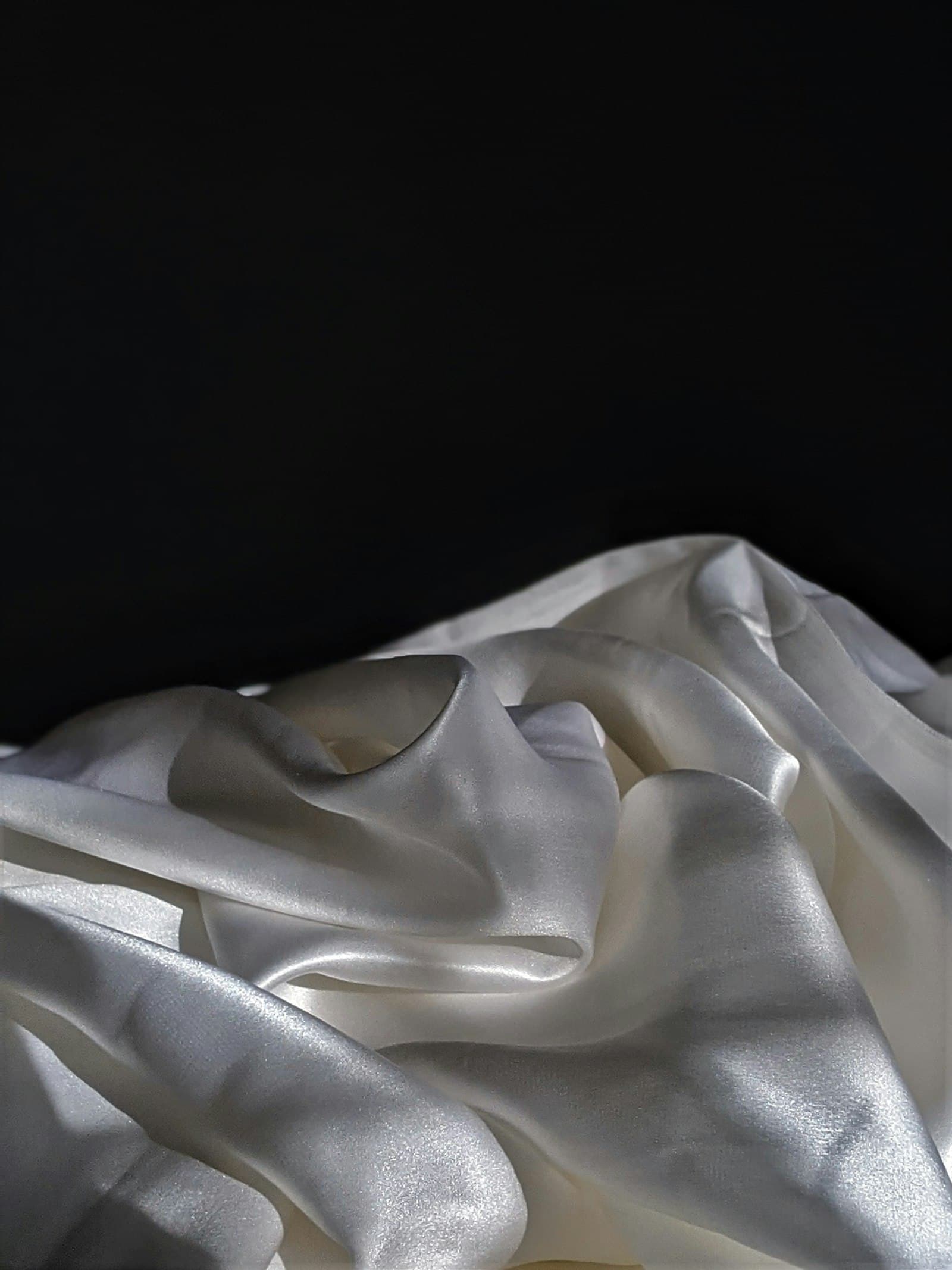
An August night, the window ajar, the heat of the whole day still standing in the room. A hand searches the pillow for a cooler place and finds it at once, because silk gives up warmth faster than skin can hand it over.
That first impression lasts a dozen seconds and is entirely physical. Then the fabric equalises with the body and ceases to exist, which is, in truth, the best thing that can be said about a material you sleep in.
Where the coolness comes from
Silk conducts heat better than cotton, so in the first moment it draws warmth off the skin faster. Hence the sensation of coolness, which has nothing to do with the temperature of the room: the cloth is exactly as warm as everything around it, it simply settles the difference more quickly.
The second half of the answer concerns moisture. Silk fibre can take on around a tenth of its own weight in water without feeling wet, and releases it into the air faster than cotton, which prefers to keep it. At night, when the body sheds surplus heat through the skin, that difference is noticeable.
This is why silk can work in both directions: cooling in heat and not chilling in winter, because a layer of air stays trapped between its fibres. It is not magic but a consequence of a protein filament with a triangular cross-section.
Hair and the pillow
A cotton pillowcase has a surface of short fibres standing above the weave. A hair sliding across it at night catches on them hundreds of times, and by morning it shows: static ends, tangling at the nape, that characteristic wave on one side of the head.
The smooth face of a silk satin weave offers far less resistance. Hair glides instead of catching, so there is simply less mechanical damage. It will not rebuild ruined lengths or replace a pair of scissors, but it limits the harm that accumulates night after night, for years, unnoticed.
The greatest difference is seen by people with curly, fine or coloured hair, because in those three cases friction costs the most. Everyone else mostly notices that mornings take less time to put a head in order.
It is worth remembering that a pillowcase works only where it is. If the head spends half the night pressed into an arm or into a cotton duvet, the effect proves far smaller than a change of pillowcase promises on its own. Sometimes a soft band holding the hair in one place does more than a whole set of bedding.
Skin, sleep lines and moisture
Pillow marks on a cheek in the morning come from pressure and friction at once. A fabric the skin glides over leaves fewer of them and they usually fade sooner. That is an observation rather than a promise, and it concerns mostly how the first hour of the day looks.
The second point is less spectacular and more concrete. Cotton absorbs everything: water, sebum, the cream applied in the evening. Silk absorbs considerably less, so a product stays where it was put instead of migrating into the pillowcase within the first hour of sleep.
It is worth keeping the proportions honest. A pillowcase is not a treatment and will replace neither sleep, nor water, nor a sensible cream. It is a condition that spoils nothing and happens to be pleasant, and that is enough.
Dust, mites and the hygiene of a bed
A dense silk weave of high momme is a less hospitable place for dust mites than porous cotton or wool, because it holds less dust and fewer fibre fragments for them to feed on. The advantage is real but frequently overstated in descriptions.
No fabric exempts anyone from laundry. A pillowcase is changed as often as any other, ideally every five to seven days, and more often for skin prone to breakouts. Silk takes this well, provided the washing is gentle.
People allergic to mites usually still need an anti-allergy mattress cover and regular airing of the bedding. A silk pillowcase is then an addition rather than a solution.
A nightdress that does not twist
The commonest complaint about a silk nightdress is that it travels: it rides up at the waist and winds around the body. The cut is usually responsible, not the cloth. A bias-cut piece settles around the figure and returns to place with every turn; a straight-cut one stays wherever movement has carried it.
Weight matters too. Six to eight momme gives a veil that looks beautiful and starts showing light through its seams after two washes. Sixteen to nineteen momme has the heft that pulls the cloth down and keeps it near the body without clinging.
Then come the details that only reveal themselves at night: no stiff label at the nape, flat seams at the sides, a strap wide enough not to cut into the shoulder when lying on one side. None of these are learned in a fitting room; they are learned at three in the morning.
The evening that prepares the night
Sleep begins long before anyone lies down, and it does not begin with fabric. It begins with the temperature of the room, which suits most bodies best between eighteen and twenty degrees, and with light that in the last hour should be warmer and hung lower than it was all day.
Changing for the night is a signal in this ritual rather than a formality. The body learns the order of events faster than it learns the hour, so a nightdress taken from a drawer at the same time each evening does more for falling asleep than another application full of breathing exercises. What matters is repetition, not the grandeur of the gesture.
Hair is gathered loosely, high above the nape, with a soft band free of any metal joint, or into a careless plait. A tight knot pulls on the roots for eight hours and leaves a kink no brush will comb out in the morning. The rest of the evening belongs to the pillow.
How to look after silk bedding
The rules are the same as for any other silk, only applied more often. Cool water up to 30°C, a delicates programme, a mesh bag for the pillowcase, the lowest possible spin. A gentle detergent without enzymes and without optical brighteners.
Fabric softener is unnecessary here and actively harmful. Silk is soft on its own, and a film of silicones takes away its lustre and its ability to take up moisture, precisely the two qualities it was chosen for.
It dries in shade, flat or over a line padded with a towel, never in a dryer and never in the sun, which breaks down dye and weakens the fibre. Two pillowcases used in rotation last longer than four used one after another, because cloth needs rest exactly as shoes do.
A well-slept night leaves no evidence, neither on the face nor on the bedding.
In the morning the pillow looks the way it did in the evening, and what went on there for eight hours has left no proof at all. The hair does not remember the night, and neither does the cheek.
Sleep is the only thing we do for a third of our lives without witnesses. The fabric that takes part in it deserves to be chosen with the same attention as the one shown to the world, even though nobody will ever see it.