
Behind the Scenes
Hands That Know Silk: Inside the YES VERSE Atelier in Bielsko-Biała
7 min read
At a quarter past seven, the atelier still belongs to the light. The sun comes in from the east through tall windows and lays a long, slanted band across the cutting table — first over the rulers and the weights, then over a bolt of ivory silk. The bolt was unrolled last night so the fabric could rest flat until morning. That is not poetry; it is procedure. Silk remembers every tension from winding and transport, and a night of rest lets the fibres settle back into their natural order. Only then may a blade touch it.
The cutter arrives first. Before she takes off her coat, she runs a palm across the tabletop, checking for anything that could snag a thread: a speck of grit, a forgotten pin, the rough ghost of old tape. The gesture looks like habit, but it is the first quality check of the day. In the YES VERSE atelier in Bielsko-Biała, the day begins with surfaces, not machines.
A City That Understands Cloth
Bielsko-Biała is no accidental address. For two centuries the town on the river Biała lived off wool: its clothiers' workshops grew into full-scale industry in the nineteenth century, when people called Bielsko the Manchester of Silesia. The soft mountain water was unusually good for washing and dyeing wool, so spinning mills, weaving sheds and finishing plants rose along the river. Some of those buildings are apartments and museums now, but the craft did not evaporate with the steam from the chimneys.
In a city like this, sewing is not exotic — it is professional memory. There are hands here that learned pattern and cut from mothers and master seamstresses long before anyone coined the phrase slow fashion. When the atelier looks for people to work with silk, it does not start from zero; it starts from a tradition that only needs retuning, from wool to a fabric far more temperamental.
First, the Silk Has to Lie Down
Laying silk on the table is a discipline of its own, one no label ever mentions. The satin weave makes the fabric glide over itself and over any smooth surface — on a lacquered tabletop, charmeuse literally flows, the way spilled water looks for a slope. So cutting paper goes underneath, paper with a fine, matte micro-texture. Under the fingertips it feels like tissue with a grain so faint you only notice it when your hand slides; that grain holds silk in place the way frosted glass holds a droplet.
Silk is laid in a single layer, never stacked, and it is never pulled taut. Instead of stretching, weights; instead of pinning across the surface, pins only in the seam allowances, because silk remembers every puncture and can carry the mark of a pin longer than many a seam. The warp thread has to run perfectly parallel to the table's edge: silk laid askew becomes lingerie that starts to twist around the body after its first wash instead of flowing down it.
The Blade Moves Differently Than on Knit
Knit forgives. Its looped structure springs back, and a small error of the blade disappears into the fabric's natural stretch. Woven silk forgives nothing: its threads are strung tight as wires, and every wobble in the cutting line stays in the finished piece forever. So the hand guiding the blade over silk works differently — slower, smoother, without lifting the edge off the paper.
The cutter works in long, calm strokes, the lower blade of the shears sliding along the tabletop without raising the fabric a single millimetre — lifted silk shifts instantly and the line escapes. The blades must be freshly sharpened; a dull edge does not cut silk so much as drag it, and one dragged thread can pucker the whole width of the cut. In the atelier they say you can cut knit over a conversation. Over silk, the conversation goes quiet on its own.
A Size-60 Needle and the Skin of Your Hands
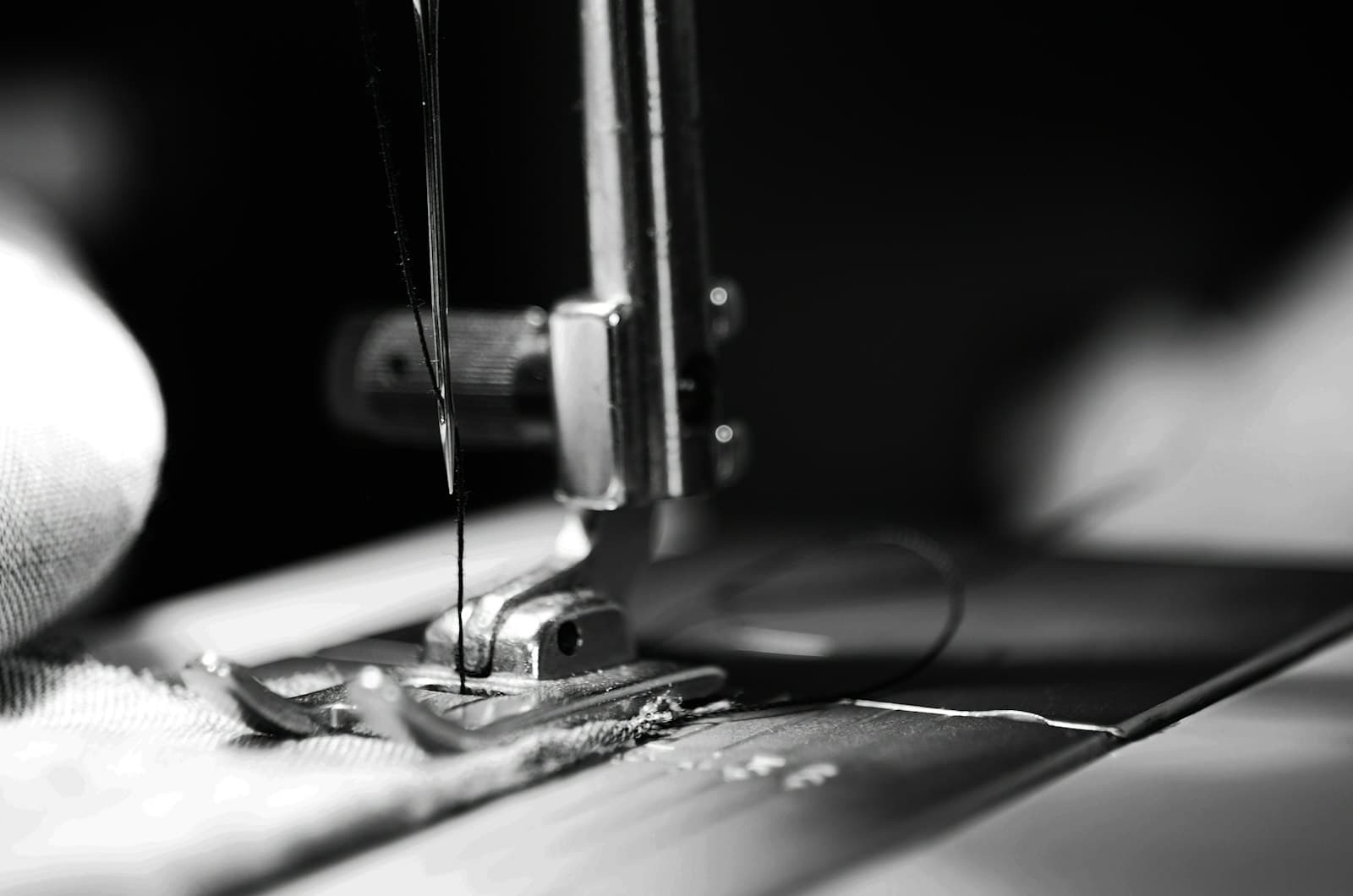
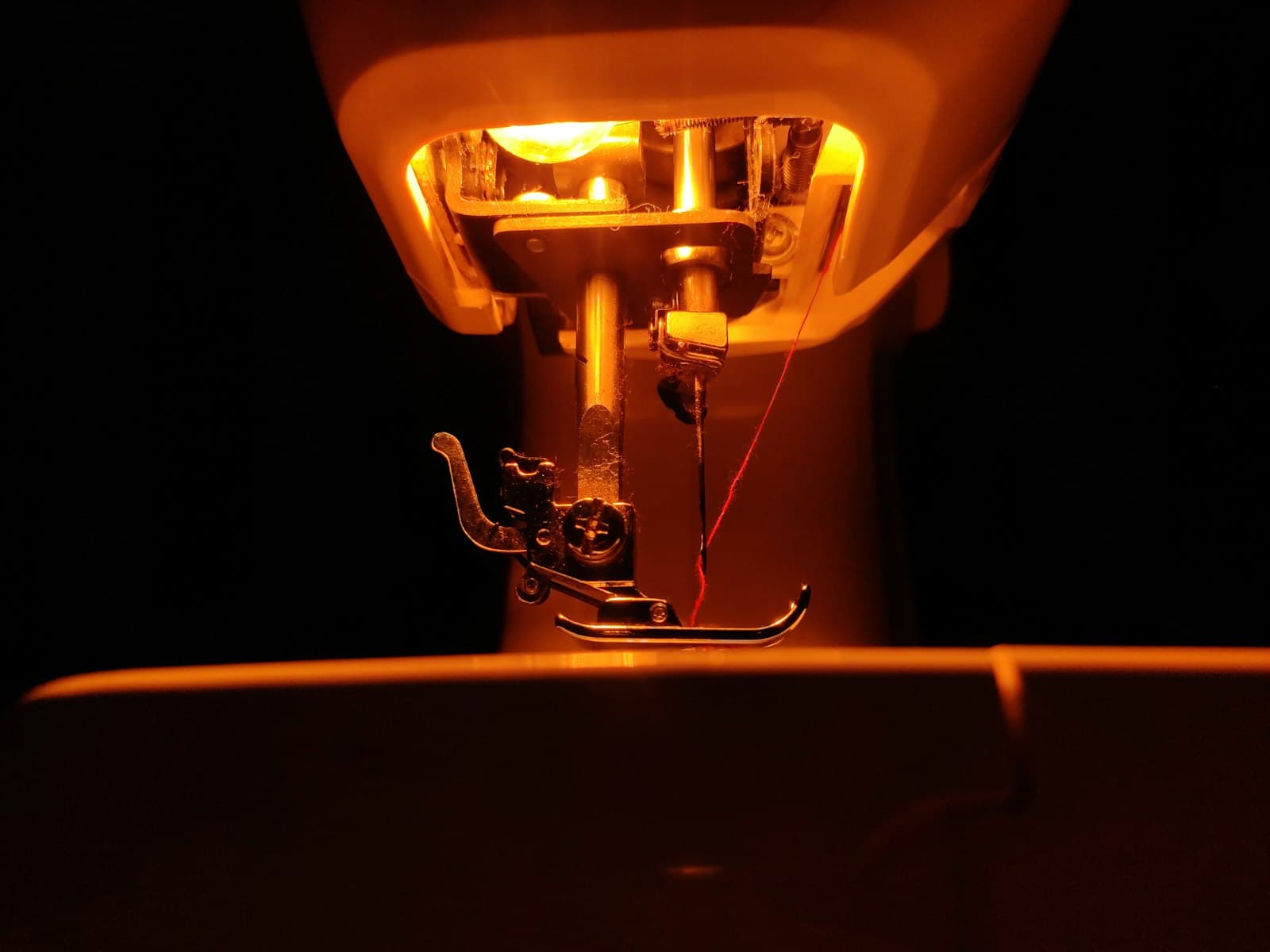
At the machines, an arithmetic of small things applies. Silk gets the thinnest needles used in the atelier — size 60, with a point that parts the threads of the weave instead of piercing them. Such a needle is replaced more often than anyone counts: one pass through a thick seam junction is enough to raise a microscopic burr on the point, and a burr on the needle means pulled threads along the entire seam. The thread is chosen finer than common sense suggests, and the stitch is shortened, because a small stitch spreads tension across more points and the seam ripples less.
And there is one thing no sewing manual mentions: the skin of your hands. Charmeuse catches on everything — a torn cuticle, dry skin, a ring. In the atelier, hand cream stands next to the needle box and is treated as a tool, not a cosmetic. In winter, the season of dry skin, the seamstresses say silk becomes audible: the faint rustle of fabric drawn through the hand betrays every roughness before you can see it on the cloth.
Leavers Lace and the Seam You Cannot Feel
The hardest moment of the day comes when two different natures meet: smooth silk, heavy with its own sheen, and openwork Leavers lace. This lace is made on looms whose design dates back to the nineteenth century, many of them still working in northern France; the pattern is knotted from thousands of bobbins of gossamer yarn, slowly, at a rhythm that cannot be hurried without destroying the drawing. Fabric like that deserves a seam that does not embarrass it.
Which is why lace is joined to silk with a flat seam. The allowance does not stand up inside it; it lies spread flat — no edge presses into the skin, and the inside of the garment looks almost as clean as the outside. The scallops of the lace must mirror each other on both sides, to the single arc. It is work measured in millimetres and in breath: when lace is being sewn on, the radio in the atelier goes off, because a stitch guided every two millimetres along an openwork edge does not tolerate divided attention.
Silence in an atelier is not the absence of sound. It is a form of attention that silk simply deserves.
Daylight Does Not Lie
Quality control happens at the window, not under a lamp. Artificial light flattens fabric and smooths over exactly what should be noticed; daylight shows everything — a single pulled thread, a minimal difference in stitch tension, a shadow lying a touch too wide along a seam. Every piece is examined twice: against the light, to check the evenness of the openwork and the clarity of the silk, and flat, to see how it settles on a surface.
Then comes the test no optics can replace: drawing every seam between thumb and forefinger. The hand feels what the eye cannot see — a single harder point, a tiny knot, the trace of a needle. If the fingers stop even once, the piece goes back to the table. Not to the bin; to be corrected. The difference between those two words is precisely the difference between manufacturing and craft.
The Last Stitch of the Day
In the afternoon the light changes sides of the table, and the atelier falls quiet in sequence: first the overlocker, then the lockstitch machines, finally the iron. Pressing silk is its own ritual of caution — low heat, always through a cotton cloth, always from the reverse, because overheated silk loses its lustre for good and no amount of steam will give it back. The last piece sewn does not go straight into a box — it lies spread out until morning, just as the bolt of fabric lay in the morning. Silk closes the day the same way it opened it: with rest.
It is easy to say that luxury is a label, a price, a sheen. In Bielsko-Biała it looks humbler and more serious at once: luxury is the hours that never show — the night a fabric spends resting, the minute of silence over a centimetre of lace, the second look by the window when the first one found nothing. Hands that know silk do not learn it from a course. They learn it over years, piece by piece, stitch by stitch. And that is the whole secret — there is no secret here at all.