
Guides
Size Is Only the Beginning: A Guide to the Fit You Feel but Never See
7 min read
The label holds a number and a letter. The mirror holds you. Between the two lies an entire story: the cut, the fabric, the brand, the time of day, the day of your cycle — even whether you took your measurements in the morning or at night. Size is the language lingerie uses to describe a body. And like any language, it loses something in translation.
Good fit carries a paradox: once it is there, it stops existing. You don't adjust a strap at midday, you don't tug the band away from your ribs, you don't feel that telltale evening relief of taking off something that has been digging in since breakfast. This guide leads exactly there — with a soft measuring tape, a few unhurried minutes, and not a single word about „figure flaws”, because no such thing exists.
Why eight in ten women wear the wrong size
Fitting studies have repeated the same stubbornly stable figure for years: roughly 80 percent of women wear a bra that isn't their size. The pattern is almost always identical — a band too loose, a cup too small. The result: the full weight of the bust hangs from the straps, while the structure that was meant to support merely keeps it company.
It's hardly surprising. Most of us measured once — often as teenagers — and then spent years rebuying the size we had „always worn”. And sizing is no universal standard: a Polish 75B is a British 34B, a French 90B and an Italian „terza”, and two brands can sew entirely different cups under the same label. Habit begins to impersonate comfort. The problem isn't a lack of knowledge — it's a measurement taken a decade ago.
The wrong size is rarely a measuring mistake. It's a measurement from years ago: the body moved on, the label stayed.
Two measurements that are enough to begin
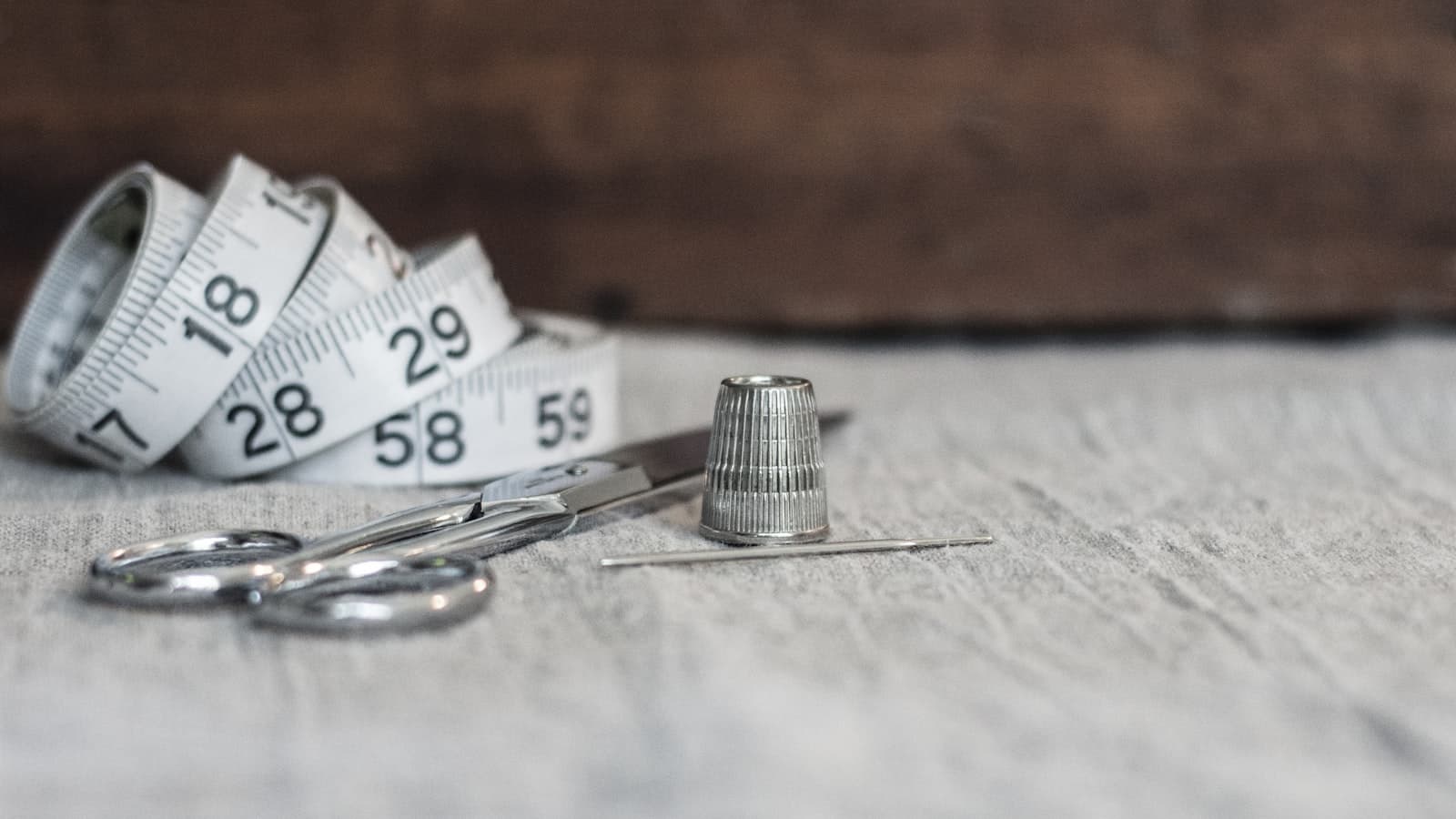
You don't need a professional fitting room for an honest measurement, though a good bra fitter is never a bad idea. You need a tailor's tape, a mirror, and five minutes in which nobody is rushing you.
- Underbust: place the tape directly under your bust, horizontal and parallel to the floor. It should sit firmly without cutting into the skin. Measure on a calm exhale — this is the circumference you'll be breathing in all day.
- Bust: measure at the fullest point, usually at nipple level, in a soft unpadded bra or none at all. The tape should rest lightly, flattening nothing, still parallel to the floor.
The difference between those two numbers points to your cup: as a rule of thumb, every further two centimetres means the next letter. Treat it as a starting point, not a sentence — charts differ between brands, and two women with identical measurements may need entirely different cuts. Then there's the time of day: in the evening the body is slightly fuller than in the morning, so if you want a truly honest measurement, measure twice — after waking and before bed — and take the middle value. Don't pull your stomach in, don't stand to attention. You are measuring the body you live in, not the one that poses.
Sister sizes: one volume, three labels
Few people know that cup volume isn't attached to the letter alone but to the band-and-letter pair. A B cup on a 75 band holds exactly as much as a C on a 70 or an A on an 80. These are sister sizes: move the band down one step and the letter up one — the volume stays the same.
Why does this matter? First, it rescues you when the model you love doesn't come in your size — a sister size can be an excellent stand-in. Second, it explains why one brand's 75C can fit like another's 70D. Third, it lets you fine-tune: if the band is right but the cup gapes, go down a letter; if the band rides while the cup fits, take a smaller band with a bigger letter. One caveat: strap length and the spacing of the cups change along with the band, so a sister size deserves a try-on, not just arithmetic.
Signals that the fit is off
Your body sends its messages long before you consult a size chart. Here are the most common — and what they actually mean:
- Straps digging into your shoulders — this is almost never the straps' fault. The band is too loose to carry the weight, so it hands it to your shoulders. The cure is a smaller band, not thicker straps.
- The band riding up your back towards the shoulder blades — the band is too big. A well-fitted bra draws one level horizontal line, front and back.
- Lace or the top edge of the cup standing away at the neckline — the cup is slightly too big, or its shape simply doesn't cooperate with yours. Sometimes a letter down solves it; sometimes it takes a different style.
- The bust escaping over the top or the side of the cup — the cup is too small, even if „the size is right”. Trust the fabric, not the label.
- Marks on the skin that don't fade within a few minutes — a band too tight, or a cut drawn for someone else's proportions.
A single signal is a hint, not a verdict. Two or three at once — that is an invitation to measure again.
Silk doesn't forgive. Which is exactly why you can trust it
Elastane knits come with built-in diplomacy: they stretch wherever the size missed the body by a centimetre or two, and quietly mask the difference. Woven silk knows no such courtesy. It has a natural, subtle give — especially cut on the bias, as most good slips and camisoles are — but none of the elastic „forgiveness” of knits. It will not stretch to cover a mistake.
In practice this means two things. Silk that is too small tells you immediately: horizontal strain across the hips, creasing at the waist, straps under tension. Too big, and it collapses into empty, bodiless folds, losing the liquid drape you chose it for. So with silk lingerie, go by your chest and hip measurements, and between two sizes choose the larger: a bias cut settles beautifully onto a body it has been given room for, and adjustable straps do the rest.
What sounds like severity is in fact silk's greatest virtue: it never lies. When it fits, it truly fits — and you have certainty, not a compromise stretched over elastane.
Bodies change. Fit is a practice, not a verdict
The most overlooked truth about sizing: there is no single answer forever. In the second half of the cycle the bust can be fuller by half a cup and the ribcage by two centimetres, as the body holds more water. Tissues swell slightly in summer heat and settle again in winter. Add weight changes, sport, hormonal contraception, pregnancy and nursing — each writes its own version of those two numbers.
So instead of one „true size”, know your range. Fasten a new bra on the loosest row of hooks — the other rows exist to absorb both the body's fluctuations and the fabric's natural stretch over time. Keep something in the drawer for fuller days, and don't treat them as a deviation from the norm. They are the norm. And come back to the tape roughly every six months — not to police yourself, but so that your lingerie keeps up with you, rather than the other way round.
The fit you never see
The best lingerie is the kind you forget a minute after putting it on. No adjusting, no counting the hours until evening — just silk behaving as if it had known your body forever. Size is merely the key to that: a number and a letter where the fitting begins, not an identity to defend.
Start tonight. A tape, a mirror, two measurements — and once more tomorrow morning, for honesty's sake. You may confirm what you have known for years. Or you may discover you have spent all this time wearing the size next to yours — and that the difference, nearly invisible on a label, turns out on the skin to be all the difference in the world.